


The Welcome Garden
The garden is inspired by Hans Christian Andersen’s fairy tales and his unique way of seeing the world. It was designed by the landscape architects MASU Planning in collaboration with architects from Kengo Kuma & Associates.
Imaginative, colorful, surprising, and filled with space for many different kinds of plants, ornamental grasses, and perennials. This is how the Welcome Garden greets the museum’s visitors, whether they have traveled from afar or are simply passing through.
Travel, sensory discovery, and experiencing the world in new ways are fundamental themes in the fairy tales of Hans Christian Andersen, and these same themes form the basis of this part of the garden. There are no specific fairy tales or characters here; instead, it is the shapes, colors, and fragrances that speak to the senses and the imagination.
Hans Christian Andersen’s universe is multifaceted and complex, without a single center, and in much the same way the garden forms a labyrinthine world. Winding paths invite visitors and passersby inside, guiding them through its various garden spaces. Sometimes you are above, sometimes below; perspectives shift, and the only certainty is that you never know what awaits around the next corner. Like an Hans Christian Andersen fairy tale you have not yet read, the garden is simply waiting to be explored.

The Sunken Gardens
The garden’s changes in level help create a sense of narrative and wonder, offering surprises for guests and passersby.
Just as Hans Christian Andersen plays with perspective in his fairy tales, there are differences in level throughout Hans Christian Andersen’s Garden. The museum covers an area of 5,600 square metres, two-thirds of which lies underground. The same is true of two of the garden spaces, the Sunken Gardens, which add depth to the museum complex and create a connection between the buildings, the exhibitions, and the greenery outside. Here, treetops are at eye level and the forest floor is at the museum’s basement level. With a difference in elevation of six metres, the two sunken gardens create disappearing acts and surprises for visitors, whether they are indoors or outdoors.
In the Large Sunken Garden, historic tree species such as oak and alder, together with a small lake, evoke memories of the classic Danish woodland landscapes that Hans Christian Andersen often described in his writing. Plantings of ferns, wild ginger, and sweet woodruff spread like a soft, lush carpet, creating the illusion of a natural forest floor. Small footbridges frame the landscape and create beautiful tableaux that invite quiet contemplation.
In the Small Sunken Garden, a woodland floor and alder trees welcome visitors arriving from the underground parking facility. At the same time, they provide a refreshing glimpse of greenery for motorists passing beneath the museum.

The garden of Giants
Here, even the tallest guest can feel as tiny as Thumbelina.
Readers of Hans Christian Andersen’s fairy tales delight in his ability to tell stories from unexpected points of view. In one of his fairy tales, they see the world through the eyes of a tin soldier; in another, from the perspective of an aphid or an oak tree. The poet’s ability to shift his focus broadens our view of the world, allowing us to see familiar things through entirely new and imaginative eyes. With Hans Christian Andersen’s help, the world is transformed.
Nowhere is this more evident than in The garden of Giants, where visitors find themselves surrounded by enormous, almost oversized plants. Even adults can feel as small as Thumbelina beneath the giant leaves of species such as giant rhubarb, empress tree, and rice-paper plant. As visitors follow the winding path, they will discover how it gradually narrows and becomes more enclosed, wrapping them in a world of foliage, fragrances, and colours—as though, for a moment, they themselves occupy a larger place in the world.
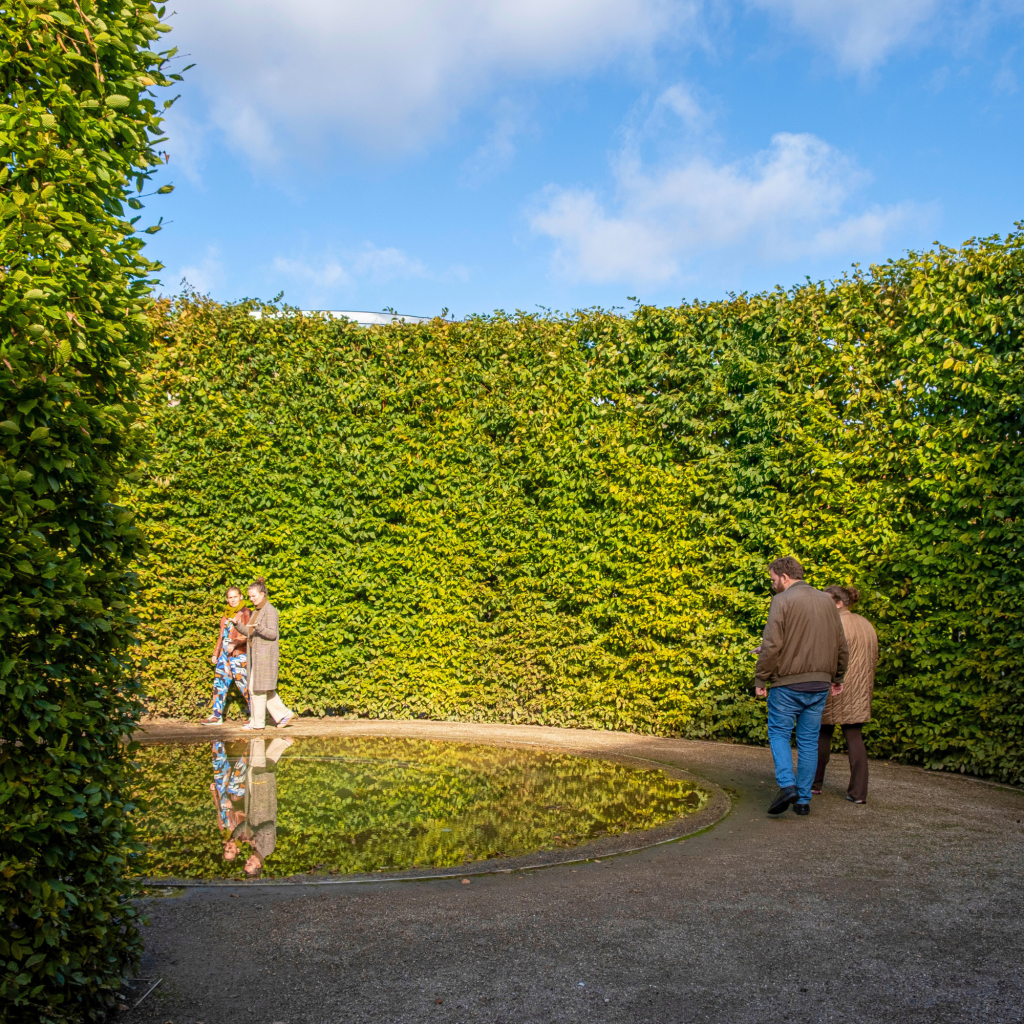
The Mirror Lake
The portal between the sky and the underworld.
The Mirror Lake draws the sky down between the trees, like a shimmering canvas set among the winding hedges. If visitors could see through the water, they would have direct access to the exhibition below, where The Little Mermaid swims and gazes longingly toward the land above. Just as she does, guests inside the museum can look up through the water’s reflective surface to the drifting clouds—or the falling rain—beyond. They stand in the very heart of the fairy tale.
The changing seasons continuously transform the colours and character of the winding hornbeam hedges, giving Hans Christian Andersen’s Garden a dynamic and ever-changing quality. In summer, it becomes a green labyrinth; in winter, a transparent wall. Along the edges facing the city, the hedges are deliberately kept with a light branch structure, allowing glimpses into the garden from the surrounding urban space. At the centre, hedges of beech and yew create denser, more enclosed garden rooms, offering a sense of intimacy and discovery.

The Dark Garden
The darkness and loneliness that permeate the fairy tales can also be experienced in the garden.
Hans Christian Andersen’s universe is not only bright and playful. Many of his fairy tales contain a darkness and loneliness that he knew from his own life, just as he also wrote perceptively about people’s thoughtless treatment of one another and of nature. It is this darkness that visitors encounter in The Dark Garden.
In The Dark Garden, the bright foliage of the beech hedge gives way to dark yew, while dense spruce trees block out the light. Climbing plants such as dark honeysuckle and creeping, gnarled weeping beech help create an intense and atmospheric setting. Perhaps it also reminds visitors of trolls and the hidden folk from the old legends Hans Christian Andersen knew so well and drew upon in his fairy tales. Just look at the drooping Finnish spruce trees—why do they hang their heads like that?

The Bright Garden
After darkness comes light, as the highest point of Hans Christian Andersen Garden is The Bright Garden.
At the highest point of the garden, flowers and foliage have been carefully selected to create a playful and vibrant character, with colours and fragrances changing throughout the flowering season. Spring begins with shades of purple and white, giving way to the summer months’ explosion of colour from perennial flowers, including sea holly in blue tones and sneezeweed in red and yellow.
The composition of plants in Hans Christian Andersen’s Garden has been carefully designed to highlight the changing seasons, with each planting bed following its own sequence of blooms throughout the year. Through a variety of textures, scents, shapes, and colours, the plants create distinctive atmospheres. At the same time, the many different flowers, grasses, hedges, and trees provide habitats for a rich diversity of birds, insects, and butterflies.
From the viewpoint in the Bright Garden, it becomes clear how the hedges have been clipped to reflect the scale of the city: tall hedges facing the modern part of the city with its high-rise buildings, and lower hedges towards the centre of the garden and the historic districts.

The Tree of light
The maple tree that inspired the ceiling structure of the new building.
The old maple tree is known as “The Tree of light” because it was once used to hang Christmas lights during the festive season. That is no longer the case. Today, the tree has space to grow freely. Very much in the spirit of Hans Christian Andersen, it stands as a witness between the new district and the old neighbourhood that existed in Andersen’s time.
The museum’s Japanese architect, Kengo Kuma, and his colleagues took the tree into account when designing the building towards which it reaches. The building houses the children’s universe, Ville Vau. Like the tree itself, the centre of the building is equipped with a trunk-like structure that branches out into a beautiful ceiling construction in the museum’s Atelier.
In much the same way, the crown of the “The Tree of light” plays an important role in the way daylight enters the Atelier. Its branches filter the light indoors, creating an effect that changes with the seasons and the tree’s foliage. In this way, the tree still lives up to its popular name.
The maple is the largest tree in Hans Christian Andersen’s Garden, but it is far from the only one. A total of 37 trees have been planted, including silver maple, ginkgo, and mountain pine.

The West Garden
An open gateway to a playful world in the heart of the city.
The West Garden lies at the edge of Hans Christian Andersen’s Garden and helps extend the green landscape into the city, while at the same time creating a gateway to Hans Christian Andersen House.
This part of the garden features some of the same meadow grasses, hedges, perennials, and trees found throughout the rest of Hans Christian Andersen’s Garden. It is also here that the area’s transport routes—the Light Rail and the Super Cycle Highway—are integrated into the landscape. Café Deilig is located in this section of the garden as well.
In the West Garden, museum visitors and city residents move from the bustle of everyday life into Hans Christian Andersen’s playful and storytelling universe. Here, the senses are awakened, and everyone is invited to engage their imagination. It is also here that visitors bid farewell to the fairy tales and the rich palette of colours that characterises them.
The interpretation of Hans Christian Andersen’s Garden has been realized with support from the Danish Business Promotion Board as part of the project “Cities for Culture.”
